“Only monsters play God.”
So runs the tagline of Guillermo del Toro’s new cinematic masterpiece. And such is the popular understanding of the storyline and takeaway of Mary Shelly’s classic horror novel, Frankenstein.
But is that really the lesson?
This is not to say that this cannot be a good lesson. After all, a hallmark of a good story is one that might have various melodies across time but always resonates. And thanks to readers and interpreters like del Toro, we catch a melody that suggests we might be misreading Frankenstein when we stop at “only monsters play God.”
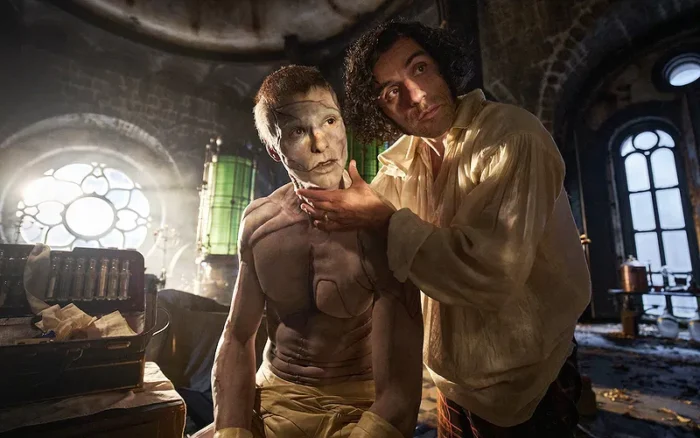
As Parul Sehgal recently put it after spending time with del Toro, “the monster is not born but made — by Victor’s revulsion, his abandonment, his refusal to care for that which he has created. Victor himself experiences brief and awful flashes of guilt. Mary [Shelly] makes a transitive verb out of the word ‘compassionate.’ Listening to the creature’s account, Victor registers that ‘his words had a strange effect upon me. I compassionated him, and sometimes felt a wish to console him, but when I looked upon him, when I saw the filthy mass that moved and talked, my heart sickened and my feelings were altered to those of horror and hatred.’” And yet in response to this hatred, the creature still feels a sense of attachment to the creator. This is one of the “unbearable” dynamics for Sehgal, especially as the creator who the creature appeals to continues to spurn his cries and even cries out himself “for relief from the sight of this ‘detested form.’ And the creature reaches out to cover Victor’s eyes with his own hands, to spare his creator the sight of himself — ‘Thus I relieve thee, my creator,’ he says, ‘thus I take from thee a sight which you abhor.’ His tale,” Sehgal concludes, “is the story of the unrequited love of the child for the parent — the shame of dependency; the bottomless, almost perplexing willingness to forgive.”
Given this deep emotional mangling, it seems odd that our lesson from this story is “only monsters play God.”
In order to better understand the point Shelly is trying to make in the story, we might read her alongside a fellow master of story, J.R.R. Tolkien.
Tolkien gives us a better appreciation for what made the monsters of Frankenstein. In his 1939 essay “On Fairy-stories,” Tolkien introduced an idea that would become a centerpiece of his theology, scholarship, and his own mythmaking. He called it “sub-creation.” Sub-creation was a “power” by which humans made “immediately effective by the will the visions of ‘fantasy.’” Sub-creation was distinct from “either representation or symbolic interpretation of the beauties and terrors of the world.” It was a true type of ‘creation.’ If done well, sub-creation resulted in new life and even “belief” (though Tolkien had a lot of qualifiers around what he meant by ‘belief’).
Sub-creation entailed a certain kind of divine imaging for Tolkien. And so if he were to critique the figure of Frankenstein, much of that read would stem from Tolkien’s deep respect for humanity’s power of “sub-creation.” Sub-creation resulted from the coming together of “the incarnate mind, the tongue, and the tale,” Tolkien wrote. It was the uniquely human ability to conjure up worlds and realities that were different from the perceived ones. This power, Tolkien argued, was one of the ways in which humanity imaged God as Creator:
“Though now long estranged,
man is not wholly lost nor wholly changed.
Dis-graced he may be, yet is not de-throned,
and keeps the rags of lordship once he owned,
his world-dominion by creative act:
not his to worship the great Artefact,
man, sub-creator, the refracted light
through whom is splintered from a single White
to many hues, and endlessly combined
in living shapes that move from mind to mind.
Though all the crannies of the world we filled
with elves and goblins, though we dared to build
gods and their houses out of dark and light,
and sow the seed of dragons – ‘twas our right
(used or misused). That right has not decayed.
We make still by the law in which we’re made.” (from “Mythopoeia”)
Tolkien underscored the final two lines: “Abusus non tollit usum” – ‘the abuse does not take away from the use.’ For ultimately, “we make in our measure and in our derivative mode, because we are made: and not only made, but made in the image and likeness of a Maker.”
Yet as wonderful, powerful, and potent as this gift was, Tolkien also saw the ways it was often and persistently misused, even abused. One of the parts of Tolkien’s “On Fairy-stories” that repeatedly jumps out to me comes as Tolkien describes the storied virtue of ‘escape.’ To be clear, for Tolkien, the virtue was “escape” and not “escapism.” The difference was between “the Escape of the Prisoner” (true escape) and “the Flight of the Deserter” (escapism). After he gave that distinction, Tolkien moved to the very first example in his mind of what this ‘escape’ might look like. It might, he said, be found in a decision “not to mention (indeed not to parade) electric street-lamps of mass-produced pattern in your tale.” Such a decision proceeded “From a considered disgust for so typical a product of the Robot Age, that combines elaboration and ingenuity of means with ugliness, and (often) with inferiority of result. These lamps may be excluded from the tale simply because they are bad lamps; and it is possible that one of the lessons to be learnt from the story is the realization of this fact.” That so many people, regardless of their literary taste, longed for the days of bows, trees, and castles, was part of the greatest critiques of the modern world for Tolkien. “It is part of the essential malady of such days – producing the desire to escape, not indeed from life, but from our present time and self-made misery – that we are acutely conscious both of the ugliness of our works, and of their evil.” And so humans were enchanted and taken in by tales of ancient days in hopes of escaping their misery that was, at the end of the day, “self-made.” And escape was a way of realizing and reckoning with this fact . “Many stories out of the past have only become ‘escapist’ in their appeal through surviving from a time when men were as a rule delighted with the work of their hands into our time when many men feel disgust with man-made things,” Tolkien explained. Sub-creation could and had been abused. And given that the first thing Tolkien thinks of in regard to sub-creation and escape was the built environment and the work of human hands, we are left with the sense that Tolkien’s hopes for the race of sub-creators were not exclusively literary.
Horror is the result of our abuse of sub-creation, not its use. And, if Mary Shelly is to be believed, that abuse is not exclusively about the ends to which we set our powers of sub-creation (though that is certainly a factor). Rather, the abuse of our powers of sub-creation is determined by how care-less we are when we engage them (and when we start them). The monstrous abuse of sub-creation comes when the creator hates the work of their hands.
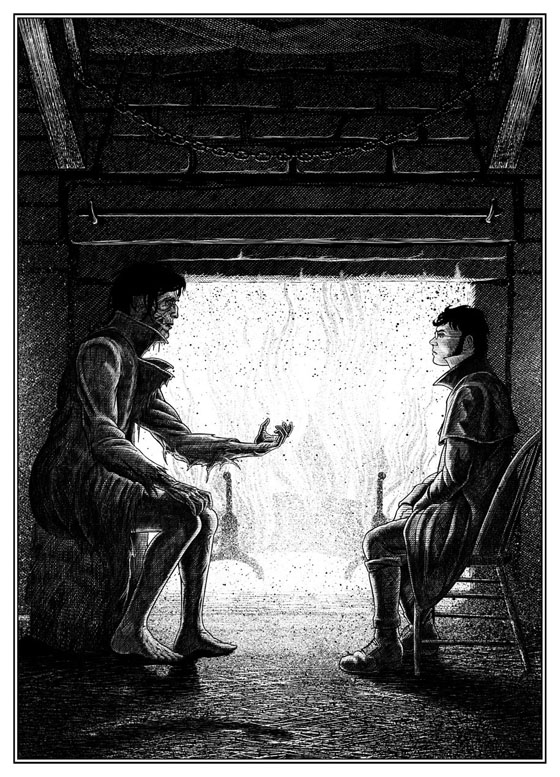
That this is the interpretive key to Frankenstein comes when the creature first “dares” to approach its creator in the book. “Devil, do you dare approach me?” Frankenstein demands of the creature. The creature expected such a welcome, and yet the pain was still sharp. “You, my creator,” he retorts, “detest and spurn me, thy creature, to whom thou art bound by ties” of sacred obligation. “I am thy creature, and I will be even mild and docile to my natural lord and king if thou wilt also perform thy part, the which thou owest me. Oh, Frankenstein, be not equitable to every other and trample upon me alone, to whom thy justice, and even thy clemency and affection, is most due. Remember that I am thy creature; I ought to be thy Adam, but I am rather the fallen angel, whom thou drivest from joy for no misdeed.” This was the creature’s greatest challenge, to suggest that his creator aught to do something, that there was more to life than simply bestowing it. Yet this was also the creature’s greatest despair. “You, my creator, abhor me; what hope can I gather from your fellow creatures, who owe me nothing?”
That the failure to properly play creator is the horrible crux of the story is underscored by the fact that, in both the book and del Toro’s adaptation, the creature, not the creator, gets the final word. It is why the novel itself ends with the heartbroken, grief-filled, enraged lament of the creature over what he realizes to be his own dehumanization, or his ultimate monstrification, as he is shamed and abandoned. “Once I falsely hoped to meet with beings who, pardoning my outward form, would love me for the excellent qualities which I was capable of unfolding…But even so; the fallen angel becomes a malignant devil. Yet even that enemy of God and man had friends and associates in his desolation; I am alone.” And it was out of this pain that the creature sought to inflict pain on Frankenstein – an approach that the creature realizes did nothing to bring newness. “For while I destroyed his hopes, I did not satisfy my own desires. They were forever ardent and craving; still I desired love and fellowship, and I was still spurned. Was there no injustice in this? Am I to be thought the only criminal, when all humankind sinned against me?” But with Frankenstein dead and cold, there was no remedy, no ear left to hear. And so the book ends with the creature’s stinging critique of his creator: If anyone was supposed to love me, the creature cries, you were.
Based on the creature’s critique of Frankenstein’s misuse of sub-creation, I find it compelling that del Toro’s film comes to us again now in 2025. From AI to authoritarianism, it is easy, even right, to critique a misguided god-complex. For those of us in the Reformed tradition, it is one of the most radical aspects of our confessional lives to proclaim that governments and leaders are neither Lord nor God (see the Theological Declaration of Barmen). But from AI to governments, it is equally right and good to address the ways we detest – even despair over – the work of our hands. What Tolkien’s read of Frankenstein helps us hear is not a call to abdicate the “right” and power of sub-creation. Indeed, any attempt to do that just means we exercise sub-creation in ignorance. For Tolkien at least, it doesn’t seem like humans can get out of “making” and sub-creation, it is both a right and a “law.” To ignore this power is to be blind to all that you are already pouring into the works of your hands (as del Toro’s Frankenstein is blind to the pain and fear that infused his creature). The call, instead, is to realize and fulfill the obligations of creating, and to love the work of our hands.
“Only monsters play God.” Not quite. Especially if the “God” here is the God of Genesis, who, given Shelly’s framing, is perhaps the type of God she and her readers had in mind. The God of Genesis was a type of Creator who not only created ex amore but made sure that every creature knew that it was “good” and “very good.” And more than that, this was a Creator who saw and heeded the needs of a creature, and declared from the beginning that “it is not good for it to be alone” (Genesis 2:18).
If we read Shelly with Tolkien, what made Frankenstein an egotistical monster was that he did not fully or adequately play God. For as opposed to the God of Genesis, Frankenstein hated the work of his hands. And in turn, this monstrous posture was a brokenness that perpetuated itself. As the creature reflects on the tragedy he has fomented in his pain, he glances down at what I imagine to be palms open and held out before him. “I look on the hands which executed the deed; I think on the heart in which the imagination of it was conceived and long for the moment when these hands will meet my eyes, when that imagination will haunt my thoughts no more.” As Frankenstein hated the work of his hand, so his Work hated the work of his own hands. That we have yet to be sufficiently harrowed by this horror is perhaps a testament to the ways we tend to misread Frankenstein. And perhaps it is the reason why, even after almost 120 years since it was initially published, someone like Tolkien could still describe the ways humans wished to escape from all they themselves had made.
Frankenstein was not a monster because he created, because he exercised the “right” of sub-creation. He was a monster because he hated the work of his hands. He was a monster, in other words, because he did not fully “play” God.

Brilliant, Kristofer! Yes!